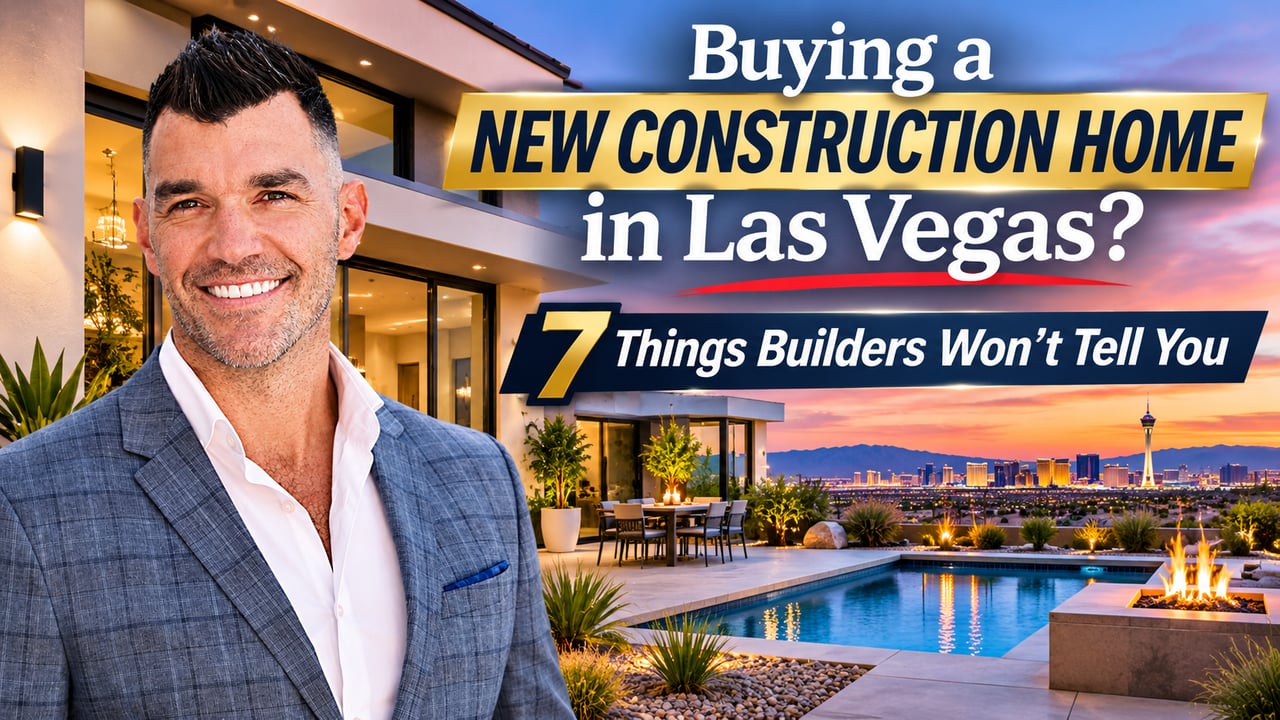
Buying a New Construction Home in Las Vegas? 7 Things Builders Won't Tell You
By Joey Andron | Las Vegas & Henderson REALTOR® | Simply Vegas
There's something about walking into a brand-new model home.
The kitchen looks incredible. The furniture is perfectly arranged. The lighting is just right. And somehow, every room feels bigger than it probably is.
I've walked through hundreds of model homes over my real estate career, and I'll admit, even I still appreciate a beautifully designed model.
But here's something I've learned after more than 20 years in real estate, including working directly for a homebuilder and managing a new-home community in Summerlin:
The builder is selling you a house. My job is to help you figure out whether you're actually getting a good deal.
Those are two very different things.
I've represented buyers purchasing new construction throughout Las Vegas, Henderson, Summerlin, Inspirada, Cadence, and Lake Las Vegas. I've worked with some of the largest builders in Southern Nevada, and I've seen how differently two buyers can come out of essentially the same transaction.
Sometimes the difference comes down to knowing what to ask, when to negotiate, and which incentives are actually worth taking.
If you're thinking about buying a new construction home in Las Vegas, here are seven things I think you should know before walking into a model home.
1. The Builder's Sales Representative Doesn't Represent You
Let's get this one out of the way first.
When you walk into a model home, the person greeting you is usually friendly, knowledgeable, and genuinely helpful.
They'll walk you through the floor plans, explain the upgrades, and tell you about the available homes.
But here's what buyers sometimes misunderstand.
That sales representative works for the builder. Not for you.
Their responsibility is to the company selling the home.
That doesn't mean they're dishonest or trying to take advantage of anyone. I've worked alongside some excellent builder sales representatives over the years.
But if you're negotiating the purchase price, reviewing contract terms, or trying to determine whether the builder's financing package is competitive, wouldn't you want someone representing your interests?
I certainly would.
Why your first visit matters
One mistake I see buyers make is visiting a new-home community without their Realtor and assuming they can bring their agent into the transaction later.
Not necessarily.
Many builders have registration policies that require your agent to accompany you or be identified during your first visit.
If you register independently, the builder may not recognize your agent for compensation purposes later. Policies vary, so this should be confirmed before visiting.
My advice is simple: Talk to your Realtor before visiting a builder's model home.
And if you're already working with an agent, make sure you understand the builder's registration requirements.
2. The Advertised Price Is Rarely the Price of the Model Home
You've probably seen advertisements for beautiful new homes starting in the $400,000s or $500,000s.
Then you visit the model, fall in love with the kitchen, the flooring, the sliding glass doors, and the backyard.
And that's when you discover the home you're standing in may cost considerably more than the advertised starting price.
Here's why.
The base price often doesn't include everything you're seeing.
Depending on the builder, you could be paying extra for:
- Lot premiums
- Upgraded cabinets and countertops
- Flooring throughout the home
- Additional lighting and electrical upgrades
- Extended sliding glass doors
- Upgraded bathrooms
- Backyard landscaping
- Window coverings and certain appliances
I've seen buyers become so focused on the model home's appearance that they don't realize how quickly the upgrades add up.
And there's another expense that deserves attention.
The lot premium
Not every lot in a new-home community costs the same.
A larger lot, corner lot, elevated lot, or property with a desirable view may carry a substantial premium.
Sometimes that premium is justified.
Other times, I think buyers are paying far too much for a lot that doesn't offer much of an advantage.
For example, I would be cautious about paying a large premium for a lot that backs up to a busy street or has limited backyard usability.
And in Las Vegas, backyard orientation matters.
A west-facing backyard can receive intense afternoon sun during the summer. That's something you might not think about when touring a model home in February.
My advice: Before committing to a lot, understand exactly what you're paying for and compare it with other available homesites.
You can change flooring and countertops later.
You can't change your lot.
3. Builders Have More Room to Negotiate Than You Might Think
This is probably the biggest misconception I encounter.
Buyers assume that because they're purchasing from a large national builder, the price and terms are nonnegotiable.
That's simply not always true.
I've negotiated purchase prices, closing cost contributions, mortgage rate buydowns, lot premiums, and other incentives on behalf of my clients.
But here's the important part.
Not every builder negotiates the same way, and not every home offers the same opportunity.
A builder selling homes in a popular community with limited inventory may have very little incentive to negotiate.
A builder sitting on several completed homes may have an entirely different attitude.
A real example: How I negotiated $44,400 in builder concessions
I recently represented a buyer purchasing a $740,000 new construction home in Lake Las Vegas.
Through negotiations, I secured a builder concession equal to 6% of the purchase price.
That's $44,400.
The negotiated package helped us accomplish three things:
First, we bought down the mortgage interest rate to 4.5%.
Second, we negotiated assistance covering the buyer's closing costs.
Third, we secured six months of prepaid HOA dues.
The exact application of concessions depends on lender guidelines, financing terms, and the final settlement figures.
But the bigger point is that we negotiated a financing and closing-cost package that made a meaningful difference for my client.
And that's something buyers need to understand.
Sometimes negotiating a lower purchase price makes the most sense.
Other times, a substantial closing cost contribution or mortgage rate buydown can provide more immediate financial benefits.
You have to run the numbers.
Why builders sometimes prefer incentives over price reductions
Builders often have an interest in maintaining pricing within their communities.
If they significantly reduce the price of one home, that sale could affect comparable values and the perceived pricing of their remaining inventory.
That's one reason some builders prefer offering financing incentives or closing cost contributions instead of directly lowering the purchase price.
It isn't universal, but it's something I consider when negotiating.
And it's why I don't approach every builder transaction the same way.
4. The Best Deals Are Often on Homes That Are Already Built
If someone asked me where I would start looking for a new construction deal in Las Vegas, I'd probably begin with completed inventory homes.
These are often called quick move-in homes or standing inventory.
They're homes that are already built or nearing completion and haven't been sold.
Why do I like them?
Because the builder has already committed the money to construct the home.
And every month that home remains unsold, there can be additional carrying costs.
That doesn't automatically mean the builder is desperate to sell.
But it can create an opportunity.
What I look for when negotiating standing inventory
I pay attention to how long the home has been available, whether the builder has multiple similar homes sitting unsold, and what competing communities are offering.
I also look at the builder's reporting periods and whether there are incentives tied to closing within a particular timeframe.
Sometimes a home that's been available for several months presents a better opportunity than a dirt lot where construction hasn't even started.
But there's a trade-off.
With a completed home, the builder has already selected many of the finishes and upgrades.
You may not get to choose the flooring, cabinets, or countertops.
Personally, if the finishes are attractive and the numbers make sense, I'd seriously consider that trade-off.
I'd rather see a buyer get a great deal on a completed home than spend tens of thousands of additional dollars customizing a house simply because they wanted to pick every finish.
Of course, that depends on the buyer.
If you're building your long-term dream home and want specific design features, choosing your own finishes may be worth the additional cost.
5. That Low Mortgage Rate Might Not Be as Simple as It Sounds
You've probably seen builder advertisements offering mortgage rates that look considerably lower than the rates available through traditional lenders.
And sometimes those offers are genuinely attractive.
But buyers need to understand what they're actually getting.
Is the advertised rate fixed for the entire loan term?
Is it a temporary rate buydown?
Does the offer require using the builder's preferred lender?
Are there additional fees or financing conditions?
And most importantly, how does the complete loan package compare with what another lender could offer?
Temporary vs. permanent rate buydowns
These are two very different things.
A temporary buydown, such as a 2-1 buydown, reduces the borrower's effective payment rate during the first two years.
After that, the payment is calculated using the loan's full note rate.
A permanent rate buydown generally involves paying discount points to secure a lower interest rate for the life of the loan, assuming the loan remains in place.
Neither is automatically better.
It depends on your financial situation, how long you expect to keep the mortgage, and the cost of the buydown.
Don't compare interest rates alone
I encourage buyers to compare Loan Estimates from multiple lenders.
Look at the interest rate, APR, closing costs, discount points, lender fees, and total cash required to close.
Also consider what happens if you refinance or sell sooner than expected.
A builder's preferred lender might offer the strongest overall package.
But you won't know that unless you compare.
My advice: Don't let an attractive advertised interest rate distract you from the total cost of the loan.
6. A Brand-New Home Doesn't Mean You Should Skip the Inspection
This one surprises people.
Why would you need a home inspection on a house that was just built?
Because new construction doesn't mean everything is perfect.
Homes are built by people, and people make mistakes.
I've seen issues involving plumbing, electrical work, HVAC systems, grading, drainage, and cosmetic finishes in new construction.
Some are minor.
Others deserve attention before closing.
The inspections I recommend
Depending on the construction stage, I encourage buyers to consider an independent pre-drywall inspection and a final inspection before closing.
A pre-drywall inspection takes place before the walls are closed, allowing the inspector to evaluate certain components that will eventually be concealed.
A final inspection helps identify issues with the completed home.
I also recommend reviewing the builder's warranty carefully and considering another inspection before the applicable one-year warranty coverage expires.
Not every builder allows the same inspection access, and inspections have limitations, but I believe independent oversight is worth considering.
Don't assume the builder's warranty covers everything
Builder warranties vary.
Some components may have shorter coverage periods than others.
Certain items may be excluded, and there may be specific procedures for submitting warranty claims.
Make sure you understand those terms before closing.
And document any issues you discover during your walkthrough.
A new home should be exciting.
You shouldn't have to spend your first few months arguing about repairs that could have been addressed earlier.
7. Your New Home Could Be Competing Against the Builder When You Decide to Sell
This is something I wish more buyers thought about before purchasing in a developing community.
Let's say you buy a brand-new home in a neighborhood where the builder still has several years of construction ahead.
Three years later, you decide to sell.
Now imagine the builder is selling a similar floor plan down the street.
But the builder is offering a mortgage rate buydown, closing cost assistance, and brand-new finishes.
What incentive does a buyer have to purchase your resale home instead?
That's the question I want my clients thinking about before they buy.
Not all new construction communities carry the same resale considerations
I like communities such as Summerlin West, Inspirada, Cadence, and Skye Canyon for different reasons.
But I evaluate each neighborhood differently.
In an established community with limited remaining land, there may be fewer directly competing new homes.
In a developing community, buyers need to understand how much additional construction is planned.
That doesn't mean you shouldn't purchase in a growing neighborhood.
It means you should understand what you're buying into.
I also pay attention to lot position, backyard size, proximity to future roads, and whether the home has features that will distinguish it from competing properties.
For example, I'd generally prefer a well-positioned home with a usable backyard over an otherwise similar property with an awkward lot.
Because when you eventually sell, those differences can matter.
My advice: Don't evaluate a new construction home based only on what the community looks like today. Understand what it may look like five years from now.
Is New Construction Better Than Buying a Resale Home in Las Vegas?
Not necessarily.
I've worked extensively with new construction, and I genuinely believe it can be an excellent option.
But I don't think every buyer should purchase a brand-new home.
Here's how I look at it.
When I prefer new construction
I like new construction when the builder is offering competitive financing incentives, the home has a desirable lot, the floor plan fits the buyer's needs, and the total purchase price makes sense compared with nearby resale properties.
Newer systems, modern layouts, and builder warranties can also be attractive.
When I prefer resale
I often prefer resale when the buyer can purchase in a more established neighborhood, secure a larger lot, or find a home with upgrades already included.
Think about it.
A resale home that's only three or four years old might already have a finished backyard, window coverings, upgraded flooring, appliances, and other improvements.
The original owner may have spent tens of thousands of dollars on those features.
And depending on market conditions, you might be able to purchase that home for less than the cost of building something comparable today.
That's why I always recommend comparing both options.
The goal isn't to buy a new home.
The goal is to buy the right home at the right price.
Frequently Asked Questions About New Construction in Las Vegas
Do I need a Realtor when buying a new construction home?
You can purchase directly from a builder, but I recommend having your own representation. The builder's sales representative works for the builder. An experienced buyer's agent can help you evaluate pricing, incentives, contract terms, and competing properties. Representation agreements and compensation arrangements should be discussed upfront.
Can you negotiate the price of a new construction home?
Yes, in some circumstances. Negotiability depends on the builder, community, available inventory, and market conditions. Some builders are more willing to offer financing incentives or closing cost contributions than reduce the advertised purchase price.
Do builders pay the buyer's Realtor?
Many builders offer compensation to cooperating brokers, but policies and amounts vary. Compensation is negotiable and should be confirmed in writing. Buyers should also understand any obligations under their buyer representation agreement.
Which Las Vegas builders offer the best incentives?
There isn't one builder that consistently offers the best incentives.
Programs change by community, inventory, and financing conditions. I compare available homes and offers from builders such as Toll Brothers, Pulte, KB Home, Tri Pointe Homes, Woodside Homes, and others based on the buyer's needs.
The best incentive isn't necessarily the largest advertised credit. It's the package that delivers the best overall value.
Is it cheaper to buy a completed new construction home?
Sometimes. Completed inventory can create opportunities for additional incentives, especially when a builder wants to reduce unsold inventory. However, buyers should still compare the total price, included upgrades, lot quality, and financing terms.
Should I use the builder's preferred lender?
I recommend comparing the builder's preferred lender with at least one independent lender.
The preferred lender may offer incentives that make its package more attractive, but compare the complete Loan Estimates before deciding.
Should I get a home inspection on new construction?
Yes, I recommend considering independent inspections even on brand-new homes. Municipal inspections and builder quality-control procedures serve different purposes from an independent home inspection.
My Final Advice: Don't Fall in Love With the Model Home Before Understanding the Deal
I've spent more than two decades in real estate, including working directly with homebuilders, managing a new-home community, and representing buyers throughout Las Vegas and Henderson.
And here's what I tell my clients.
A beautiful model home is supposed to make you fall in love with it.
That's the entire point.
But the excitement of buying a new home shouldn't replace doing your homework.
Before you sign a contract, understand the full purchase price, financing terms, builder incentives, lot premiums, ownership costs, construction timeline, and potential resale considerations.
And don't assume that because a builder is offering an incentive, you're automatically getting a great deal.
Sometimes you are.
Sometimes there's a better opportunity down the street.
My job is to help you understand the difference.
Thinking About Buying a New Construction Home in Las Vegas or Henderson?
Whether you're considering Summerlin, Inspirada, Cadence, Lake Las Vegas, Skye Canyon, or another community, I can help you compare builders, evaluate available inventory, and identify opportunities to negotiate.
I've spent years working on both sides of new construction transactions, and I understand how builders approach pricing, incentives, and negotiations.
If you're planning to visit model homes, let's talk before your first appointment.
I'd rather help you understand your options from the beginning than have you discover later that you missed an opportunity.
Joey Andron | REALTOR®
Simply Vegas
Nevada Real Estate License S.0176729
Phone: 702-608-2220
Email: [email protected]
Website: www.luxelvhomes.com
More than 20 years of real estate experience. Specializing in new construction, luxury homes, and buyer representation throughout Las Vegas, Henderson, and Summerlin.